The Challenge
For manufacturers sourcing injection-molded plastic components offshore, the lowest quoted piece price does not always translate into the lowest total cost.
One AdvanTech Plastics customer had been dealing with the challenges that often accompany an extended international supply chain: long and unpredictable lead times, high inventory requirements, increased logistics costs, material availability concerns and the risk of receiving parts that did not meet expectations.
At one point, the customer was planning inventory requirements as much as 18 months in advance.
The company needed a more responsive domestic manufacturing solution that could provide consistent quality while reducing its dependence on long overseas replenishment cycles.
The Offshore Supply Chain Problem 
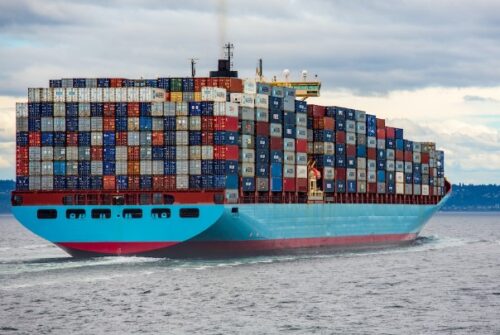
Ocean freight can help keep international shipping costs lower than air freight, but it adds considerable time between production and delivery.
Finished products must be transported to port, loaded aboard a vessel, shipped internationally, unloaded, processed and ultimately transported to the customer. When ports, trucking companies or other links in the supply chain become congested, already-long lead times can become extremely difficult to predict.
The pandemic demonstrated just how vulnerable these supply chains could be. Port congestion, container shortages and limited trucking capacity contributed to significant delays for materials, equipment and finished products.
Plastic manufacturers face another complication: resin availability is closely connected to petroleum and chemical supply conditions. Disruptions can result in allocations, shortages or force majeure declarations from resin producers.
For companies relying on offshore molding, these factors can make production planning especially difficult. Customers may be forced to order much earlier than necessary or purchase larger quantities simply to protect themselves against potential shortages.
The AdvanTech Solution: A Domestic Supply Chain
By moving production closer to the customer, AdvanTech Plastics was able to dramatically simplify the supply chain.
AdvanTech’s manufacturing operation is located within approximately a five-hour drive of the customer’s facility. Instead of planning shipments around an overseas supply chain, AdvanTech now provides the customer with regular monthly releases.
When demand changes, the company can respond much more quickly.
If the customer needs two releases during a particular month instead of one, AdvanTech has the flexibility to adjust production and delivery accordingly.
That responsiveness would be extremely difficult to duplicate with components traveling thousands of miles by ocean freight.
From 18-Month Planning to a More Responsive Inventory Model
One of the biggest advantages of reshoring was the ability to reduce the customer’s dependence on large inventories.
With offshore production, extended replenishment cycles meant the customer had to anticipate demand far into the future. Carrying extra inventory provided protection against delays, but it also tied up capital and consumed valuable warehouse space.
With AdvanTech, inventory can be replenished much closer to the time it is actually needed.
For appropriate programs, AdvanTech can provide inventory with lead times of less than four weeks, allowing customers to maintain a much leaner inventory position.
The benefit extends beyond logistics.
Reducing unnecessary inventory can:
- Free working capital for other business priorities
- Reduce warehouse and storage requirements
- Lower the risk associated with excess or obsolete inventory
- Make it easier to respond to changes in customer demand
- Reduce dependence on long-range forecasting
Quality Assurance Closer to Home
Lead time was only part of the reshoring decision for this customer.
Material verification and manufacturing quality can become especially challenging when production is located thousands of miles away.
A resin may be specified for a particular component, for example, but manufacturers still need confidence that the material actually being used matches that specification.
AdvanTech has worked with offshore mold shops where obtaining reliable Certificates of Conformance for molding materials proved difficult. In some cases, AdvanTech has shipped specified material directly to an offshore tooling supplier to ensure that sampling was performed using the correct resin.
At AdvanTech’s U.S. facilities, material documentation, production controls and traceability are integral parts of the manufacturing process.
AdvanTech operates under rigorous quality-management practices and maintains certifications including ISO 9001 and ISO 13485, along with applicable GMP and AIB requirements.
This disciplined approach provides customers with substantially greater visibility into how their components are manufactured and documented.
Avoiding the Hidden Cost of Defective Parts
Quality problems are expensive under any circumstances. They become even more costly when parts have traveled halfway around the world.
A manufacturer may plan an order months in advance, purchase a large quantity, wait through production and overseas transportation—and then discover that some or all of the parts are unusable.
Returning those components overseas for sorting or reinspection may not be economically practical. In many cases, defective parts simply become scrap.
AdvanTech Plastics approaches manufacturing with a zero-defect mentality and maintains approximately 95% on-time delivery, helping customers reduce both quality risk and supply-chain uncertainty.
Domestic manufacturing also makes communication, corrective action and production adjustments substantially easier when circumstances change.
Looking Beyond Piece Price
Historically, offshore molding frequently offered an attractive advantage based on direct labor and unit cost.
But the true cost of an injection-molded component includes much more than the quoted piece price.
Manufacturers also need to consider:
- International freight
- Tariffs and duties
- Inventory carrying costs
- Warehouse space
- Expedited shipping
- Supply-chain disruptions
- Quality problems and scrap
- Material traceability
- Production flexibility
- The cost of capital tied up in inventory
Changes in tariffs, energy prices and international logistics can quickly alter the economics of offshore production.
As freight and logistics expenses increased, the customer’s ability to obtain molded components from a nearby U.S. supplier became increasingly valuable.
The Result
Reshoring the program to AdvanTech Plastics gave the customer a shorter, more controllable and more responsive supply chain.
Instead of relying on inventory forecasts extending as far as 18 months, the customer now receives monthly shipments from a supplier located approximately five hours away.
AdvanTech can accommodate changing requirements, including additional releases when demand increases, while providing the quality documentation and manufacturing oversight expected from a highly regulated U.S. manufacturer.
The result is not simply a shorter lead time.
It is a fundamentally different approach to supply-chain management—one that can reduce inventory exposure, improve flexibility, protect product quality and allow capital to be invested in the business rather than sitting on warehouse shelves.
Considering Reshoring Your Injection Molding Program?
Moving an existing mold or product line back to the United States does not have to mean starting over.
AdvanTech Plastics works with manufacturers to evaluate existing tooling, transfer molds, validate materials and establish reliable domestic production.
Whether the objective is shorter lead times, improved quality, reduced inventory or greater supply-chain control, our team can help determine whether reshoring makes economic and operational sense for your program.
Talk with AdvanTech Plastics about bringing your injection molding program closer to home.