The Challenge
A manufacturer with a growing plastic component program needed to increase production capacity without sacrificing consistency, quality, or delivery performance.
The part itself was relatively small, but annual demand was increasing quickly. Producing the component in a low-cavity mold required too many molding cycles, extended machine time, and created concerns about whether the existing process could keep pace with future demand.
The customer needed a manufacturing solution that could produce substantially more parts per cycle while maintaining repeatable dimensions, dependable material performance, and efficient unit economics.
The AdvanTech Solution
AdvanTech Plastics evaluated the production requirements and identified high-cavitation injection molding as the most efficient path forward.
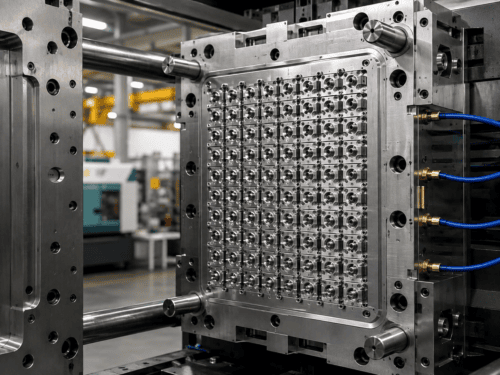
Instead of producing only a small number of parts during each molding cycle, a high-cavitation tool allows many identical parts to be molded simultaneously.
For the right application, this can significantly increase output without requiring a proportional increase in machine hours.
AdvanTech has experience supporting high-cavitation tooling, including molds with dozens of cavities and configurations reaching as high as 96 cavities.
That capability makes it possible to support demanding production programs where throughput, consistency, and cost control are all critical.
Designing for Consistency Across Every Cavity
Increasing cavity count introduces an important engineering challenge.
Every cavity must fill, pack, cool, and eject consistently.
If the mold is not properly balanced, the manufacturer can experience variation from one cavity to another, including differences in:
- Part dimensions
- Fill quality
- Weight
- Surface appearance
- Cooling
- Cycle performance
- Ejection
AdvanTech approaches high-cavitation molding with a focus on process balance and repeatability.
The goal is not simply to make more parts per shot.
It is to make more consistent, usable parts per shot.
Improving Production Efficiency
High-cavitation tooling can dramatically improve manufacturing efficiency when production volumes justify the investment.
For example, a 32-cavity tool can theoretically produce eight times as many parts per molding cycle as a four-cavity tool, assuming comparable cycle performance.
That increased output can help reduce:
- Machine hours per thousand parts
- Labor allocation per finished unit
- Energy consumption per unit
- Production bottlenecks
- Scheduling pressure during demand spikes
Higher productivity can also help manufacturers support larger annual volumes without continually adding new machines or production shifts.
Supporting Long-Run Production
High-volume programs place greater demands on both tooling and process control.
A mold running hundreds of thousands or millions of cycles must be maintained carefully to prevent wear from affecting product quality.
AdvanTech supports these programs through disciplined mold maintenance, documented processing parameters, preventive maintenance practices, and ongoing quality monitoring.
This becomes especially important for products such as caps, closures, packaging components, medical parts, and other small precision-molded components where large volumes must be produced consistently.
Automation Helps Maintain Throughput
At higher production volumes, molding speed is only part of the equation.
Parts must also be removed, inspected, handled, packaged, and sometimes assembled efficiently.
AdvanTech incorporates automation and robotics where appropriate to reduce unnecessary manual handling and help maintain consistent production flow.
Depending on the program, automation can assist with:
- Part removal
- Sorting
- Inspection
- Assembly
- Packaging
- Kitting
Integrating these processes with molding can help reduce labor dependency and improve overall manufacturing efficiency.
Quality at High Volume
Producing millions of parts only creates value if those parts consistently meet specification.
AdvanTech maintains a zero-defect mentality and supports production through disciplined quality systems, documented procedures, and process monitoring.
The company maintains certifications including ISO 9001 and ISO 13485, allowing it to support both general industrial applications and programs requiring more stringent quality controls.
High-cavitation molding also provides an important advantage: once a balanced process is established, large quantities of identical parts can be produced under highly repeatable conditions.
The Result
By transitioning to a high-cavitation production strategy, the manufacturer gained the capacity needed to support higher demand without sacrificing process control.
The program benefited from:
- More parts produced per molding cycle
- Greater production capacity
- Better utilization of machine time
- More predictable unit economics
- Reduced production bottlenecks
- Consistent quality across higher volumes
- Greater flexibility to support future growth
Instead of treating rising demand as a capacity problem, the manufacturer established a production platform designed to scale with the business.
When Does High-Cavitation Molding Make Sense?
High-cavitation tooling is typically most valuable when part volumes are high enough to justify the added tooling complexity and investment.
It can be especially well suited for:
- Caps and closures
- Medical disposables
- Packaging components
- Small precision parts
- Consumer products
- Industrial components
- Products with predictable, sustained demand
The greater the annual production volume, the more important cycle efficiency and cavity count become in determining total manufacturing cost.
Need More Capacity from Your Injection Molding Program?
AdvanTech Plastics works with manufacturers to evaluate tooling, cavity count, automation, cycle efficiency, and long-term production requirements.
Whether you are launching a new high-volume program or trying to improve the economics of an existing one, AdvanTech can help determine whether high-cavitation injection molding is the right solution.
Talk with AdvanTech Plastics about increasing production capacity through high-cavitation injection molding.
For transparency, I’d add this note at the bottom:
This case study is representative of the types of high-volume injection molding challenges AdvanTech Plastics helps manufacturers address. Specific project details have been generalized.
A strong SEO title would be High-Cavitation Injection Molding Case Study | AdvanTech Plastics, with a meta description like: See how AdvanTech Plastics uses high-cavitation tooling, automation, and disciplined process control to help manufacturers scale high-volume plastic part production.